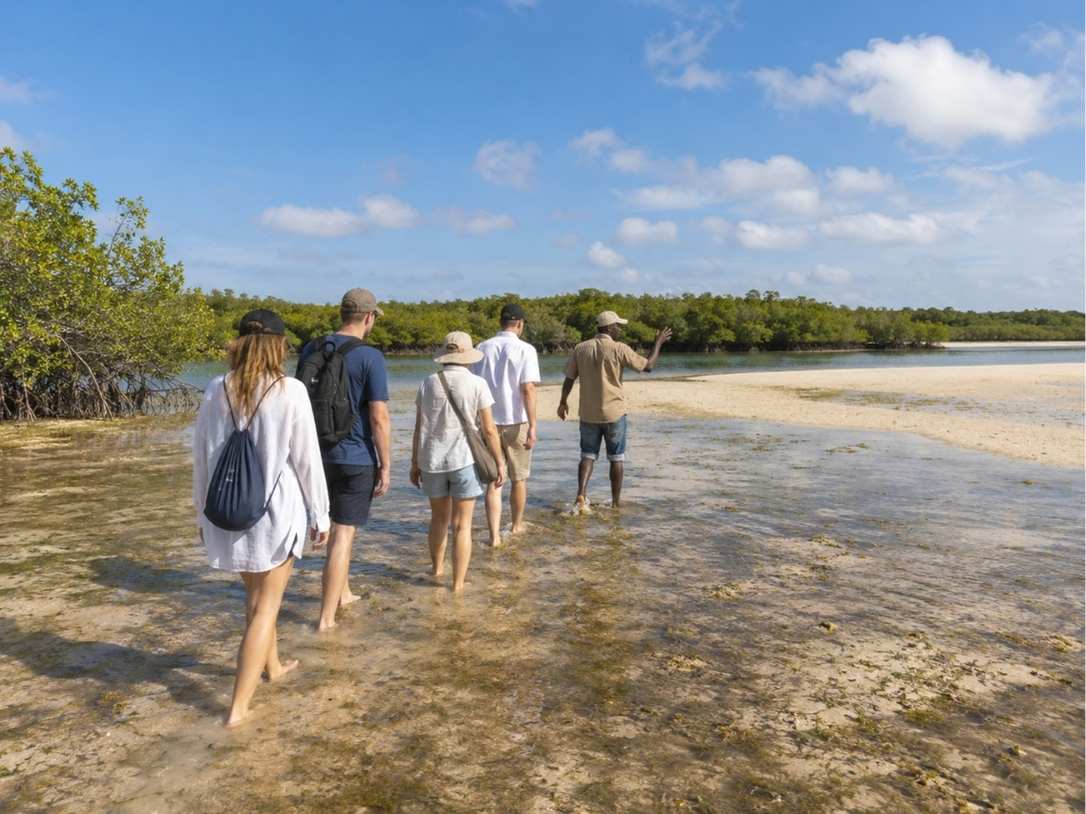
Mida Creek is never the same place twice. Over six square kilometres of tidal saltwater forest, the water rises and falls by nearly three metres with each tide, and what exists at one moment — a channel, a sandbank, a deep pool — may be entirely different six hours later.
The Timing Is Everything
The walk begins not when you arrive, but when the tide permits. Our guides monitor the tidal tables daily, and the optimal window is narrow: roughly two hours on either side of the lowest point. Arrive too early and you are wading; too late and the channels have already begun to refill, cutting off routes through the mangroves.
This is not a stroll. The creek bed is soft, uneven, and occasionally you sink to your knees in warm, silty mud. Proper footwear is essential — old trainers or reef shoes, never sandals. The guide goes first, testing each stretch, and you follow in single file because the safe path is rarely wide enough for two.
What You See
The mangroves themselves are the main event. Nine species grow here, from the stilt-rooted Rhizophora mucronata to the pneumatophore-bearing Avicennia marina, each adapted to a slightly different salinity and depth. The guide will point out the breathing roots — pencil-thin spikes that poke up through the mud like snorkels, allowing the tree to take in oxygen at high tide when the soil is waterlogged.
The fiddler crabs are the creek’s comic relief. Each male has one claw grossly enlarged, which he waves in a kind of semaphore to warn off rivals and attract females. — From the field journal of Exploreans guides
Birdlife is richest in the early morning. Herons — grey, black-headed, and the occasional Goliath — stand motionless in the shallows. Kingfishers dart between branches. If you are fortunate, you may spot the mangrove kingfisher, a species almost entirely restricted to this habitat along the East African coast.
The Human Element
The creek has been fished by the Giriama people for centuries, and you will see their traps — basket-like structures woven from mangrove fronds, placed at channel mouths to catch fish on the outgoing tide. The guides know many of the fishermen by name, and the walk often includes a conversation about what the catch has been like, which species are running, and how the mangroves have changed in their lifetimes.
This is the difference between a walk and a lesson: the guide is not reciting facts from a manual but speaking from lived experience, and the creek is not a museum piece but a working landscape.
Practical Notes
- Duration: 2.5 to 3 hours, depending on tide and pace
- Distance: Approximately 4 km of walking, mostly on soft ground
- Best time: Two hours either side of low tide; morning walks offer cooler temperatures and better birding
- What to bring: Water, sun protection, old shoes that can get muddy, and a camera with a waterproof bag
- Fitness level: Moderate; the uneven ground requires balance and the mud is tiring to walk through
The walk ends where it began, at the creek’s edge, usually just as the water is starting to creep back in. You leave with mud on your shoes and a different understanding of what “low tide” means — not empty, but revealed.