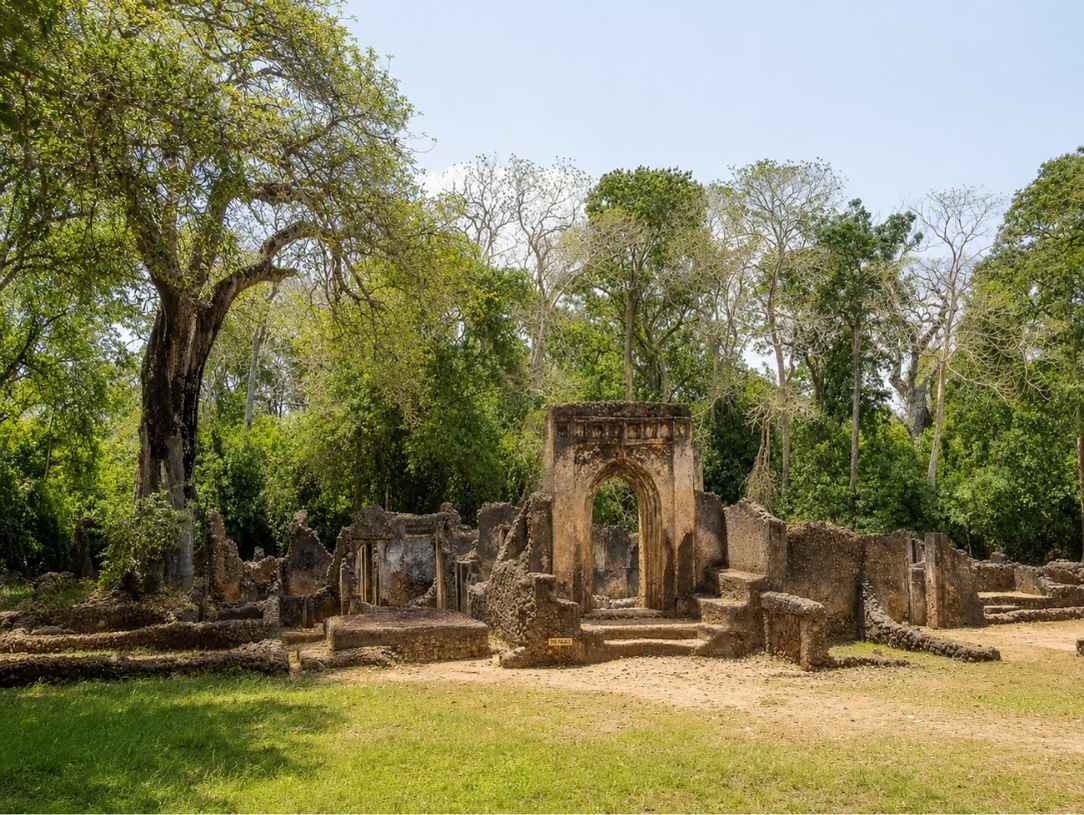
Gedi is the kind of place that makes you lower your voice without realising it. The ruins lie deep within the Arabuko-Sokoke Forest, a few kilometres inland from Watamu, and the moment you step through the gate the modern world falls away. The forest closes in. The light changes. And ahead of you, emerging from the undergrowth, are the remains of a town that was already ancient when the first European ships rounded the Kenyan coast.
What Gedi Was
The town was built in the 13th century by Swahili-speaking people, part of the maritime trading culture that stretched from Somalia to Mozambique. Gedi was not a major port — it had no natural harbour — but it was prosperous. Excavations have uncovered porcelain from China, beads from India, and coins from Arabia, all evidence of long-distance trade connections.
At its peak in the 15th century, Gedi covered approximately 18 hectares and had a population of perhaps 2,500 people. The town had stone houses, a palace, a Great Mosque, and at least four other mosques. The houses were built of coral rag — limestone quarried from the reef — with plastered walls and thatched roofs. Many had indoor plumbing, with long-drop toilets and bathroom facilities that drained into cesspits.
The Mystery of Its Abandonment
Nobody knows exactly why Gedi was abandoned in the early 17th century. The site was never reoccupied, which is unusual — typically, abandoned settlements in this region were quickly taken over by new inhabitants. Theories include: the receding of the water table, making the wells too shallow; an invasion by the Galla people from the north; or a shift in trade routes that left Gedi economically isolated.
The fig trees are the most striking thing. Their roots have worked into the walls, splitting stones apart, and in some places the trunks have grown straight through doorways. — Notes from an Exploreans guide
What to See
The site is laid out along a network of paths that wind through the forest. The Great Mosque is the most impressive structure, with its prayer hall, ablution court, and the famous pillar tomb beside it — a square tomb topped with a cylindrical pillar, a style found only in this region of East Africa and thought to mark the grave of an important religious leader.
The Palace is the largest domestic building, with a central courtyard and evidence of multiple rooms. The excavators found artefacts here that suggest the occupants were wealthy — a pair of scissors, a perfume bottle, a bronze lamp. In the museum at the entrance, you can see these objects along with pottery, beads, and the famous ‘Gedi serpent’, a coiled snake carved from bone.
Visiting Practicalities
- Opening hours: 7am to 6pm daily
- Entry fee: Paid at the gate (separate from the museum)
- Guides: Available at the entrance and highly recommended; they know the history and can point out details you would miss
- Best time: Early morning (cooler, fewer visitors) or late afternoon (golden light filtering through the forest)
- What to bring: Water, insect repellent, and sturdy shoes — the paths are uneven and can be slippery
- Duration: Allow 2 hours for a thorough visit
The site is managed by the National Museums of Kenya, and conservation work is ongoing. Some structures are partially reconstructed to show their original form; others have been left as found, with the forest slowly reclaiming them. Both approaches have their power.
Gedi is not a place for loud voices or hurried sightseeing. It rewards patience — the patience to sit on a fallen pillar and listen to the forest, to imagine the town as it was, and to wonder what happened to the people who lived here.