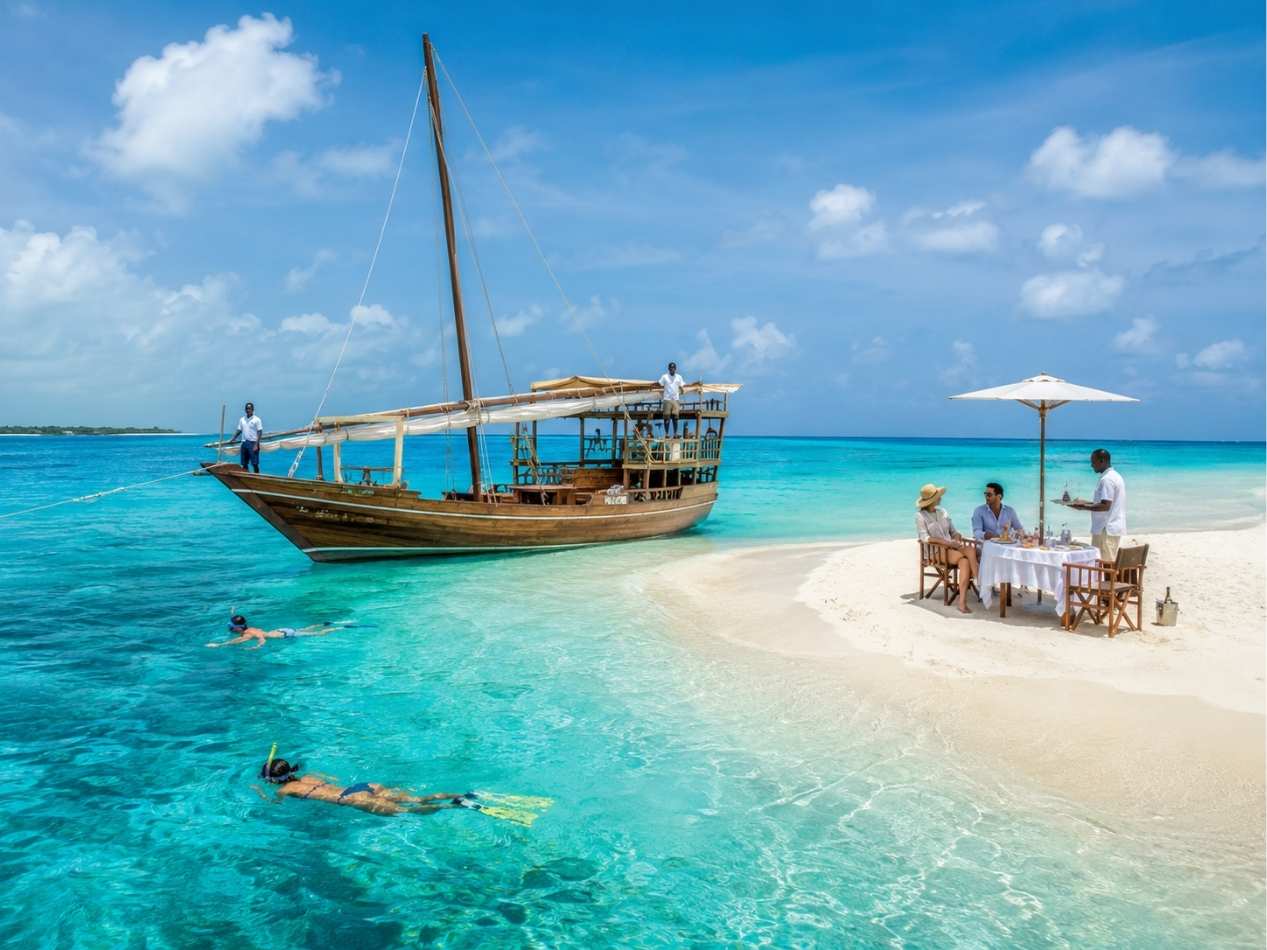
The term ‘blue safari’ is used loosely along the Kenyan coast to describe any boat trip that involves snorkelling and a beach lunch. But the original — and the one worth seeking out — is a full day on a traditional wooden dhow, sailing from Watamu into the marine park, with stops at reefs and sandbanks that cannot be reached by motorboat.
The Boat
A proper dhow is built by hand from mango wood, with a single lateen sail and no engine — or at most a small outboard for emergencies. The boats are constructed on the beach at Lamu and sailed south, a journey that can take weeks depending on the wind. They are beautiful objects: long, low, and narrow, with a prow that rises in a graceful curve.
The sailing is not fast. A dhow moves at perhaps 5 knots in a good breeze, and if the wind dies you simply wait for it to return. This is the point. The slowness is the experience. You are not travelling from A to B; you are at sea, and the journey is the purpose.
The Route
A typical day begins at 9am, when the crew raises the sail and the boat slides away from the beach. The first hour is sailing south-east, across the bay and out towards the reef. The water changes colour as you go: from the milky turquoise of the shallows to the deep blue of the channel, then back to turquoise as you approach the reef.
The sandbank appears gradually. First the water lightens, then you can see the bottom clearly, and then — suddenly — there is a crescent of white sand rising from the water, surrounded by sea on all sides. — From an Exploreans guest journal
The first stop is usually a snorkelling site on the outer reef. The Watamu Marine Park has some of the healthiest coral on the East African coast, and the fish life is extraordinary: parrotfish, butterflyfish, angelfish, and the occasional turtle or reef shark. The crew provides masks and fins, and one of them will swim with you, pointing out things you would miss.
The Sandbank Lunch
The highlight of the day is lunch on a sandbank — a temporary island of white coral sand that emerges at low tide and is completely submerged at high tide. The crew lands first, carrying coolers and a portable grill, and by the time you wade ashore they have set up a table under a canvas shade.
The food is simple and excellent: grilled fish caught that morning, coconut rice, kachumbari (a fresh tomato and onion salad), and tropical fruit. There is cold beer and soft drinks in the cooler. You eat with your feet in the sand and the sea on all sides, and after lunch you can swim, snorkel, or simply lie in the shade and watch the water.
The Return
The sail back to Watamu is usually timed to catch the afternoon breeze and the sunset. The light at this hour is extraordinary: the water turns gold, then rose, then deep blue, and the silhouettes of the dhows against the sky are the image that stays with you.
You arrive back on the beach at around 5pm, sun-tired and salt-crusted, with sand in your shoes and a memory that no resort pool can compete with.
What to Know
- Duration: Full day, approximately 8 hours (9am to 5pm)
- Group size: Dhows typically take 6-12 guests; private charters available
- What to bring: Sun protection, swimwear, towel, and a waterproof bag for electronics
- Seasickness: The dhow is stable but if you are prone to seasickness, take medication before boarding
- Best conditions: Calm mornings are ideal; the trip may be rescheduled in rough weather
- Marine park fee: Separate from the trip cost, paid at the park office
The blue safari is not a luxury experience in the conventional sense. There is no air conditioning, no fixed schedule, and no guarantee of what you will see. But it is authentic, beautiful, and utterly memorable — the kind of experience that reminds you why you travelled in the first place.